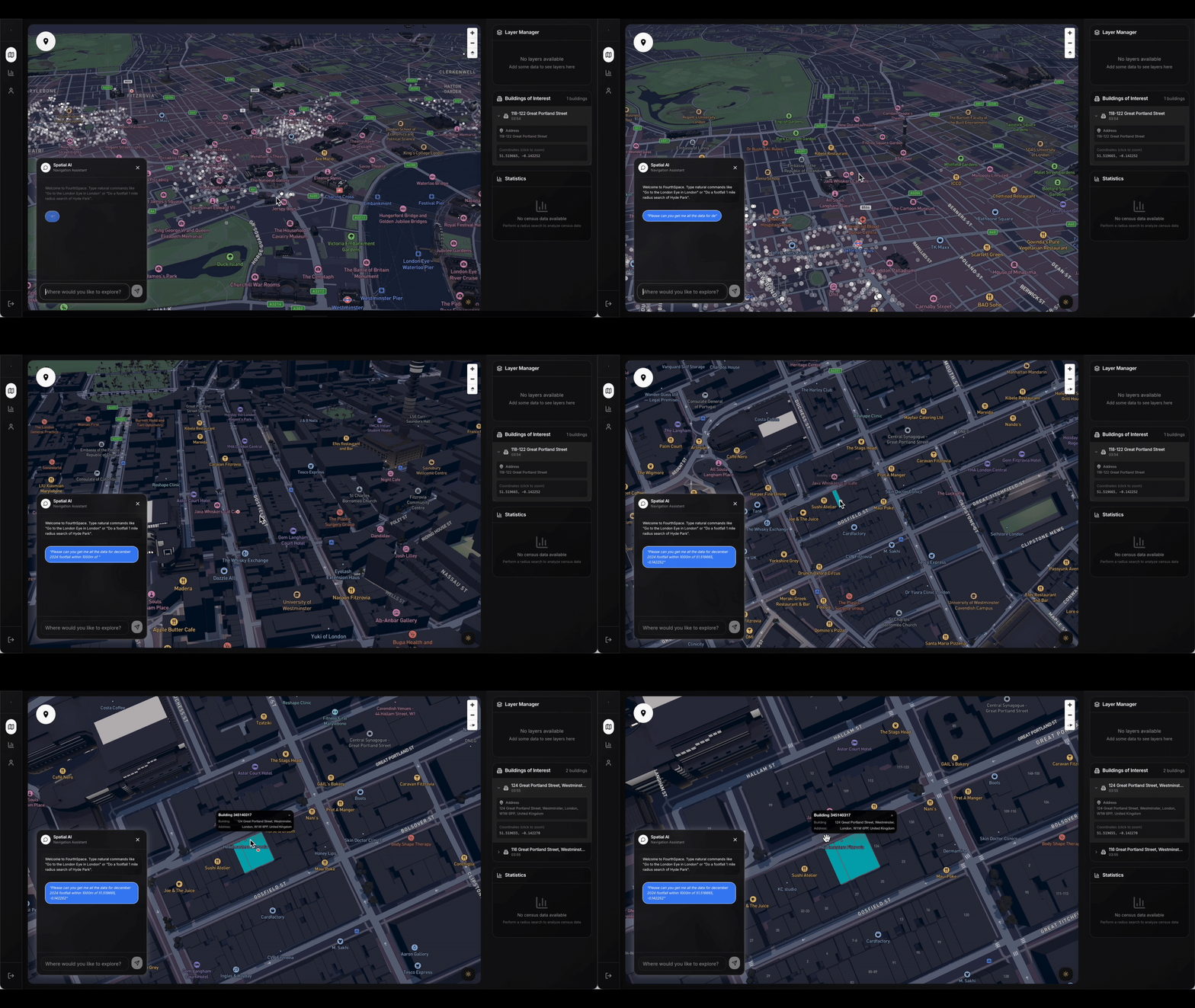
FourthSpace helps organisations make use of their spatiotemporal data to drive decisions.
We provide the foundational data layer for world models, transforming regular data into geotemporal embeddings, packed together in a neural world network that allows AI to understand and interact with physical space across multiple dimensions.
Regular organisational data is flat and disconnected from physical reality. FourthSpace quantizes events into 96-bit H3-epoch coordinates and encodes them into dense geotemporal embeddings inside a live neural world network.
Built to bridge raw organisational telemetry and frontier AI world models with deterministic spatiotemporal precision.
Ingest fragmented organisational records, mobility streams, infrastructure telemetry, and environmental feeds into a unified, cleaned spatiotemporal substrate.
Transform regular tabular and spatial records into dense multi-dimensional geotemporal embeddings that capture how places, flows, and entities co-evolve over time.
Pack geotemporal embeddings into an interconnected neural world network and OWL-ST ontology so AI models can understand, simulate, and act in physical space.
Interact directly with the neural world network through high-density 3D spatial layers, temporal flow fields, and real-time physical telemetry.
Every location is dynamically re-rendered across time, linking historical trajectories with forward-looking world model predictions.
Seamlessly traverse from continental macro-corridors down to sub-building meter resolution without losing relational context.
FourthSpace helps organisations make use of their spatiotemporal data to test counterfactuals, optimize operations, and deploy AI agents grounded in physical reality.
Query the neural world network in plain English or connect autonomous AI agents via our SDK and SPARQL/REST doors.
Tenant-isolated architecture with row-level cryptographic fences and full auditability for government and enterprise deployments.
Urban geographer Edward W. Soja proposed that space is simultaneously material and mental, measurable and symbolic—capturing lived experience as Thirdspace. Today, sensors, mobile signals, and neural world models form a continuous dialogue between matter and computation.
"If Thirdspace was the stage of lived experience, FourthSpace is its spatiotemporal counterpart - the foundational intelligence layer that perceives how physical space changes through time."
By transforming regular data into geotemporal embeddings packed inside a neural world network, FourthSpace gives AI the physical grounding required to understand, simulate, and interact with the real world across multiple dimensions.